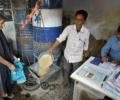
The Delhi government has cancelled over 45,000 ration cards and is considering using artificial intelligence to identify ineligible beneficiaries in its public distribution system.

India's External Affairs Minister S Jaishankar countered a US senator's claim that democracy does not put food on the table, citing India's PMGKAY program which provides food to 800 million people. Jaishankar argued that different parts of the world have different experiences with democracy and that the model of globalization has contributed to issues with democracy in some regions. He emphasized that India's democratic system effectively delivers food security, highlighting the PMGKAY program as an example.

'The decision to supply free food grains is not an economically sound decision because the government will find it very difficult in future to charge anything for food grains.'

It will also end the below and above poverty line (BPL and APL) demarcation, prevailing in the current public distribution system.

The government on Tuesday approved the revised Food Security Bill to provide for uniform 5 kg of foodgrains per month per person at a highly subsidised price of Rs 1 to 3 per kg to two-thirds of the country's population.


Karnataka Chief Minister Siddaramaiah on Monday launched payment of cash in lieu of the additional 5 kg of rice to beneficiaries under the government's 'Anna Bhagya' scheme.

A total of 15 crore people are benefiting from the programme in the state, Adityanath said.

"Fact that persons with disabilities get marginalised from every scheme does not require a debate," the court said.

Agriculture credit jumped seven-fold to Rs 7,00,000 crore (Rs 7 trillion) in the past ten years of UPA government, boosting foodgrains output to a record and enabling enactment of food law.
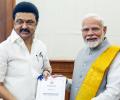
With its age-old fascination for education, southern states have done better than the North. Start-ups, IT hubs, and industry majors setting up shop have changed the face of the South. Nearly 79% of global offices set up by international conglomerates in India are in the South. Almost 46% of tech unicorns are from the South. The GDP per person in the South is 4.2 times higher than the North. None of these indicators can be ignored by any central government, whatever the political compulsions, notes Ramesh Menon.

Maharashtra is expecting its active caseload to reach 11.9 lakh by April 30, compared to the current active caseload of 5.64 lakh, Thackeray said.
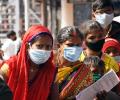
Migrant workers play a very vital role in building the nation and their rights cannot be ignored at all, the Supreme Court said on Thursday while asking the Centre to devise a mechanism so that they receive food grains without ration cards.
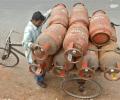
Rebuffing petroleum ministry, Siddaramaiah launches Pradhan Mantri Ujjwala Yojana-like scheme months before state polls

According to government's estimates, there are around 110 million APL families in the country, who get 11-25 kg of foodgrain a month.
.jpg)
Sakshi Balani presents an FAQ on the Food Security Bill that was passed by Lok Sabha on Tuesday.

After much delay and uncertainty, the landmark Food Security Bill was passed by the Lok Sabha on Monday which seeks to provide cheap foodgrains to 82 crore people in the country, ushering in the biggest programme in the world to fight hunger.

'Give cash assistance of Rs 75 per person per day and an android phone and you will see the economy reviving.'

'Wherever in the world there is political instability, those countries are beset with severe crises today. But India is in a much better position than the rest of the world due to the decisions taken by my government in the national interest,' President Droupadi Murmu said in her address to both Houses of Parliament.
Nowhere on the planet, nowhere in mankind's history has such an idea taken the concrete shape in form of a law. The National Food Security Bill, which will come via ordinance and not after the debate in Parliament, is an incredible economic tool to tackle the hunger of poor Indians. Also, it has already been condemned widely as a political gimmick.

There is no foodgrain shortage in the country as our total storage capacity is more than 81 million tonnes, while the public distribution system requirement is 61 million tonnes, says Ram Vilas Paswan.

Here's the full text of President's Ram Nath Kovind's address to the joint sitting of both houses of Parliament on the first of Budget Session 2022.
 © 2026 Rediff.com - Advertise with us - Disclaimer - Privacy Policy - Sitemap - Feedback - About us - Terms of use - Grievances